
Note: This text was translated using AI due to time constraints.
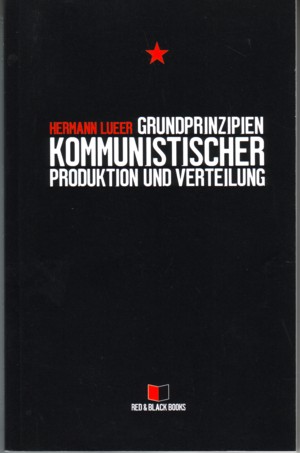
The book „Fundamental Principles of Communist Production and Distribution“ by Hermann Lueer was first published in 2018 and constitutes a promotional commentary on the book of the same title by the Group of International Communists (GIK). Lueer is already to be credited with having edited and published the GIK’s text On the Fundamental Principles of Communist Production and Distribution in its 1935 version through Red & Black Books. In this small companion volume, published by the same press, the author seeks to concisely summarize the core theses of the GIK text while at the same time criticizing common ideological justifications of capitalism and rebutting familiar objections to a socialist mode of production. The author’s aim is to “introduce, in a free form, the key statements of the Fundamental Principles of Communist Production and Distribution into the current debate on the question of alternatives to capitalism” (p. 14). For the original text—however little it may have lost its relevance—has nevertheless “remained a child of its time” (ibid.). Accordingly, the author largely comments on original quotations both from the GIK text and from Karl Marx (an important quotation is already cited in the introduction) and relates them to contemporary questions and debates, thereby advocating the Fundamental Principles text and, above all, a communist alternative beyond state socialism.
In this sense, the book begins, as it were, with an ideology-critical prelude, namely with the rejection of three well-known ideologemes by which capitalism is often justified: the self-regulating forces of the markets (“invisible hand”), technological progress, and its alleged lack of alternatives. Already here the author shows that he is capable of getting to the point without using many words. He criticizes the first point (“the invisible hand of the market”) by pointing out that capitalist markets are primarily not about satisfying needs, but about serving solvent demand, and that the market economy is therefore not efficient. Efficiency would mean “optimizing the ratio of input and output for all members of society” (p. 20), yet in the market economy efficiency ultimately means that wage laborers are treated “as a variable within someone else’s cost–benefit calculation” (ibid.). With regard to the second point, Lueer draws attention to the fact that capitalism is not the immediate reason for the existence of technological progress; rather, it is “the human intellect and the division of labor” (p. 24). These genuinely human capacities are merely extensively utilized in capitalist form “for the purpose of the private enrichment of the owners of the means of production” (ibid.), but are not produced by capitalism itself. The author addresses the third point primarily with reference to actually existing socialism. For its collapse was supposed to have clearly demonstrated the alleged lack of alternatives to the capitalist mode of economy. In this context, the author mainly cites the Austrian neoliberal pioneer Ludwig von Mises, who, against the ideas of socialist planning in kind, insists on the necessity of a unit of calculation, namely money. In line with the GIK, Lueer counters that labour time could equally serve as a macroeconomic unit of calculation. However, the author “substantiates” this merely by juxtaposing the Mises quotation with quotations from Friedrich Engels and the GIK. At this point, one gains the impression that the author may have taken a somewhat easy route. The reviewers would in any case have wished for Mises to be criticized more closely on the basis of his own arguments and in his own words. This would have lent greater weight to the objections than relying solely on quotations that do not in fact refer to Mises. Even in the section on technological progress, the aspect of the substance–form distinction between social division of labour and its capitalist form of organization could have been developed further. The author’s concise style does not always prove to be an advantage.
After this prelude, the main part begins, which then also refers directly in its content to the Fundamental Principles text. With the demand for the “socialization of the means of production” (p. 32), the most important precondition of labour-time accounting is identified, namely the abolition of private ownership of the means of production and thus also the abolition of wage labour as an alienated form of work. The critique of wage labour, expressed in easily understandable terms, is once again handled exceptionally well by the author. What is called for is labour-time accounting on the basis of common ownership of the means of production, so that each participant’s share of their own labour in the total social labour becomes transparent and surplus labour can no longer be appropriated by private owners. This is also the subject of the subsequent chapter, “The Association of Free People” (p. 38), in which the author rightly draws attention to the mutual interdependence of common ownership of the means of production and labour-time accounting. For only the latter ensures transparency and equality, whereas the mere fact of socialized or nationalized means of production without labour-time accounting could at any time also amount to an authoritarian command economy. In that case, there would merely be a replacement of elites.
According to Lueer, what is labour-time accounting ultimately about is a society-wide form of planning that nevertheless operates according to “the same economic rules” (p. 40) in both production and consumption. The initiative for planning lies with the individual enterprises, which exchange goods among themselves according to the average labour hours expended on them. Likewise, all consumers can freely exchange the labour certificates they have received for their expended labour for any consumer goods. At the level of society as a whole, this means with regard to labour certificates that they are “in substance nothing other” than “the reconciliation of the division of labour anticipated in joint planning. Through labour-time accounting, the question of distribution thus dissolves into production planning. Planning the social context of reproduction ultimately means nothing other than linking the socially necessary labour time required to satisfy needs with the sum of the individual labour available” (p. 41).
In accordance with the economic-theoretical insight presented in the longer quotation above, which we consider both correct and important, the author returns to the topic in the next section, “From Each According to Their Needs” (p. 50). This section deals with the factor of individual consumption (FIC), which regulates the proportion of public goods and services that are freely available. The hours expended on these must be deducted from and reconciled with the total number of hours. Under the principle of “From Each According to Their Needs,” individual consumption is thus reduced in favor of the public sector, where all services can be accessed without compensation. From Lueer’s perspective, large parts of the production of consumer goods and the social services sector could very quickly be transferred to the public sector. Yet even a complete transfer of production to public enterprises would not mean that labour-time accounting could be dispensed with. It is necessary precisely because it serves as an “economic measure” (p. 52). The focus is thus less on compulsion to perform—a critique often repeated by opponents of labour-time accounting—than on rational organization and the economy-wide “reconciliation” mentioned in the quotation above. Emphasizing and recording this point is one of the major achievements of Lueer’s commentary.
Under the heading “From Each According to Their Abilities” (p. 56), another important principle of labour-time accounting is addressed, namely the idea that every hour should count equally. A common objection—that complex tasks should be compensated at a higher rate because more money and time have been invested in acquiring the necessary skills, and that equalizing all tasks would devalue complex work—is rejected with the argument that in a socialist society all training costs would be borne by society, making it largely meaningless to speak of the “higher production costs” (p. 59) of labour. The author also addresses unpleasant tasks, which—if no one wants to perform them—must be weighted more heavily. This implies distributing such undesirable tasks among as many people as possible, so that individuals spend less time on them (p. 62). The author here envisions, at least in the long term, a softening of the rigid division of labour and its hierarchies structured under capitalism. Because this point is extremely important, it could have been developed further by the author, especially since it touches on issues that were underexplored by the GIK or, in the case of the differential weighting of unpleasant tasks, not addressed at all.
With the slogan “The ‘Dictatorship’ of Public Accounting” (p. 64), the substantive presentation of labour-time accounting and its fundamental principles is finally concluded. This is also the first time that councils are mentioned as the decisive administrative bodies. The author, in line with the GIK, rejects overarching state structures. Each enterprise is to be organized on a basis of direct democracy in councils and managed by the workers themselves. Public accounting assumes a society-wide control function, as it approves or rejects the plans of the respective enterprises. The decisive criteria, however, are purely factual and economic questions (such as underproductivity, insufficient demand, etc.). Hermann Lueer adopts a decidedly anti-political stance here, which is initially appealing, since he, together with the GIK, aims to show that planning can function without central state control. Yet with regard to inter-enterprise and regional decisions, his own reflections leave a gap, which is oddly filled by expert committees. As he writes: “Conceptual considerations, for example in the areas of transport, energy supply, agriculture, environment, medicine, education, etc., must be prepared factually by specialized departments of the central planning organization and, after extensive societal discussion with the population, submitted for decision” (p. 65). A benevolent reader will likely understand the intended meaning, but the formulation has a somewhat bland aftertaste. This is partly because it initially pretends that one could completely do without political superstructures, only to make clear later that certain tasks and fundamental questions affecting society as a whole must indeed be addressed at a society-wide level. It sounds a little as if one wants or dares not to say “state,” hence the term “specialized departments” is used instead. What exactly these departments entail remains somewhat unclear. Such vagueness naturally has its advantages: it imposes fewer abstract prescriptions, since, after all, people are supposed to create their own political organs and committees, and who can say exactly how this will occur? Yet regarding these political questions, one often cannot shake the impression that it is assumed that the purely economic organization of society, based on workers’ councils and labour-time accounting, is sufficient. It should be noted, however, that this deficit is primarily not Hermann Lueer’s responsibility, but rather stems from the GIK text itself, whose idea of a “General Council Congress” is also largely underdefined.
This, of course, has significant historical reasons. The Fundamental Principles text originally emerged in explicit distinction from the market- and state-socialist conceptions of the Social Democrats on the one hand, and the Bolsheviks on the other. In particular, the developments in the Soviet Union during the Civil War and thereafter—when central state control based on monetary accounting was increasingly expanded and the Communist Party gained unrestricted control over the state apparatus—served as the major negative example of a failed social revolution in the interests of the working people, against which the GIK positioned themselves. These developments are also concisely summarized by the author in the final chapter, “The Misery of Real Socialism” (p. 69). This excursus at the end initially seems to contradict his claim to update the Fundamental Principles. After all, he had stated in the introduction that the GIK was too much “a child of its time” (see above). So why return to the old debates after all? Certainly, one important answer is that the communist production and distribution envisaged here is not intended as a rehash of inefficient and authoritarian barracks socialism. Yet in that case, the critique could also—just as in the GIK text—have been placed at the beginning of the book. Addressing it at the end only makes sense if one has distanced oneself more from the original text and dealt more thoroughly with the problem of the political organization of the socialist mode of production, as was already hinted at in the chapter on the dictatorship of public accounting. These uncomfortable questions, all of which relate to the understanding of the form and function of state power under capitalism, cannot ultimately be avoided by a council-communist movement—should one ever arise—especially with regard to a strategy for revolutionary transition and the “withering away of the state” (Engels).
If these questions are avoided, one ends up saying little more than that a “successful social revolution” requires a “clear understanding of what to do with the means of production” and that “the implementation of individual labour time as a measure of the share in the product of socially necessary labour is the highest demand” “which the proletariat can make” (pp. 82f.). These statements are, of course, correct in substance, yet on their own they remain too general and therefore somewhat formulaic. This seems to be sensed by the author as well, which is why the book concludes with an epilogue that, in the author’s own words, once again summarizes the core theses of the Communist Manifesto of 1848. Regardless of the genius and foresight with which Marx and Engels composed the manifesto at the time, this rehash at the end feels somewhat disconcerting, especially since, in the very final section, the author departs from the original text to warn, following Max Horkheimer’s theory of the authoritarian state, of the ever-present threat of fascism. This creates the impression that the author initially agrees with the manifesto’s prognosis that the progressive socialization of production, combined with the growing impoverishment of the working population, will inevitably lead to a social revolution, yet he also wants to remain aware of the looming possibility of fascism. Here, one is especially left with the sense that the author has the period in which the Fundamental Principles were written more in mind than the present. While Hermann Lueer’s aim was merely to update the content of the book—and he succeeds in doing so over much of the text—his formulations at the end demonstrate that a current analysis of the present situation, grounded both in crisis theory and in labour and class sociology, as well as related strategic considerations for implementing labour-time accounting based on common ownership of the means of production, remains indispensable.
It therefore seems—at least for the time being—unlikely that in a large-scale proletarian revolution the key industries will be socialized and labour-time accounting will suddenly become the governing principle of global goods circulation. A labour-time–based economy is much more likely to initially grow on a small scale, expand only slowly, and coexist with the market economy for the time being. Socialist enterprises could draw their means of production from the capitalist circulation of goods, in which case labour certificates would have to be converted into money. Only once the labour-time economy has achieved a certain regional reach and has been able to demonstrate its economic and social advantages in practice could it become attractive to larger segments of the population—especially if, due to the ongoing capitalist crisis process, markets and political structures collapse and large portions of the working population can no longer reproduce themselves on a capitalist basis. Then an already existing labour-time economy would constitute a realistic alternative, and it might give rise to a movement advocating for a more comprehensive socialization of capitalist enterprises and their integration into such an economy.
However, such fragmentary preliminary reflections, as presented here, cannot replace the required theoretical-strategic discussion and debate, and we do not in any way wish to reproach Hermann Lueer for not undertaking this discussion in his book. Yet, particularly with regard to the epilogue, we see a significant blind spot in the debate on labour-time accounting that must be addressed both theoretically and practically in the coming years. We regard Hermann Lueer’s edition of the Fundamental Principles of Communist Production and Distribution, along with his concise commentary, as a successful starting point. Especially for young readers or those newly interested in the subject, this book offers a very accessible introduction to a highly complex topic and provides many strong arguments in favor of labour-time accounting. Moreover, the book brings together in a compact form the most important and apt quotations from Marx and Engels as well as the GIK on this subject. It would therefore also serve well as introductory or accompanying reading for self-organized reading groups or similar initiatives. In this sense, the book is warmly recommended to readers.
Hermann Lueer: Fundamental Principles of Communist Production and Distribution (german: Grundprinzipien kommunistischer Produktion und Verteilung). Red & Black Books, 2018, 102 Seiten.