
Note: This text was translated using AI due to time constraints.
I.
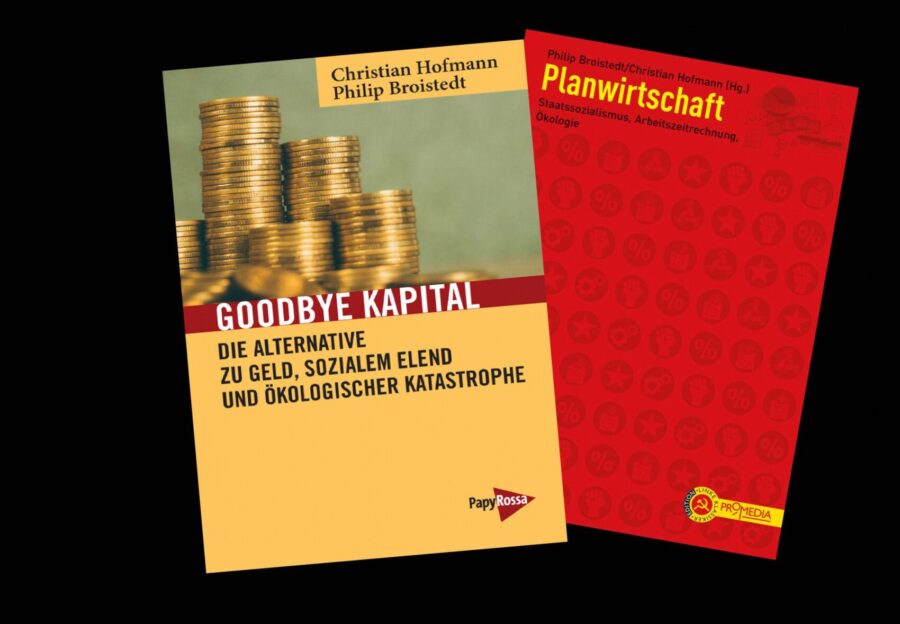
So, this time there is a double book review: “Goodbye Capital – The Alternative to Money, Social Misery, and Ecological Catastrophe” from 2020 (hereafter “Goodbye Capital”) and “Planned Economy – State Socialism, Labour Time Calculation, Ecology” from 2022 (hereafter “Planned Economy”) by Philip Broistedt and Christian Hofmann.
Our criticism of these books concerns only small, but nonetheless fine aspects of labour time calculation. Great recognition is due to Broistedt and Hofmann for their ambition to overcome commodity, money, and capital and—what is unfortunately all too rare—for bringing labour time calculation into play as an alternative. What we criticise is their tendency to treat labour time calculation as one tool among many rather than as the be-all and end-all of communist economy (in its early phase). We say: either labour time calculation is the basic principle of the associated economy or it is not; there can be nothing in between.
Nevertheless, we warmly recommend both books. Similar to, for example, Günther Sandleben’s “Society after Money – Labour Time Calculation as an Alternative” from 2022, we see in them indications of a newly emerging debate around labour time calculation.
II.
First, on “Goodbye Capital”, a book about the alternative to capitalism from a movement-left perspective. (Incidentally, Broistedt and Hofmann sometimes refer to this as Communism with a capital C.) In the first chapter, the authors draw an arc from the Arab Spring through Occupy to the current ecology movement. Their point is that social movements fail if they do not “fundamentally confront the power of the profit logic that prevails in society” (p. 11).
Broistedt and Hofmann want to break away from the idea of the “customary cyclical crises” of contemporary capitalism and instead proceed from a “general crisis, a crisis in permanence” (pp. 46, 134). In doing so, they refer to the “economic crisis” of 2008, the “unresolved sovereign debt crisis”, the “climate crisis”, “huge migration and flight movements”, and the coronavirus pandemic. Today, in the supposedly hot autumn of 2022, the list could easily be continued with housing shortages, the war in Ukraine, the energy crisis, and inflation.
According to Broistedt and Hofmann, the crisis in permanence makes it necessary to “develop answers and ideas” (p. 46). It is convincing when the authors give no answer to the central question of recent social movements worldwide, namely “How can money be put at the service of people?”. Instead, without becoming unsolidary, they point out the falsehood of the question itself. Money is put at the service of people by overcoming it (p. 80). More precisely: for Broistedt and Hofmann, only certain functions of money can be put at the service of people, namely “measuring, mediating, and representing […], not in the objectified form of another value, but immediately” (p. 82). And this, indeed, is only possible with the average labour hour.
III.
Im zweiten Kapitel gelangen Broistedt/Hofmann zu einer werttheoretischen Kritik des Geldes. Einer der Höhepunkte von »Goodbye Kapital«! Es gelingt den Autoren, auch Menschen ohne große Vorkenntnisse in politischer Ökonomie in die Arbeitswertlehre einzuführen. Ihren Anspruch, Marx in »eigenen Worten und Formulierungen« zu präsentieren, lösen sie ohne Zweifel ein. An »rechthaberischen Marx-Zitateschlachten« haben sie kein Interesse (S. 11). Sie wollen auch keinen »akademischen Text für Philosophiestudent*innen produzieren, sondern für alle verständlich sein, die sich eine andere Welt wünschen.« (S. 11) Dazu gehört für sie auch, keine Hellseherei zu betreiben, sondern gesellschaftliche Tendenzen und Implikate aufzuspüren (S. 100). Unser kleiner Einwand wäre bloß, dass sie auch mit dieser Methode mehr Flagge hätten zeigen können.
IV.
Chapter three then deals with “Plan and Labour Time Calculation”. Here, Broistedt and Hofmann outline the essential characteristics of an economy based on social ownership of the means of production and labour time calculation. In doing so, they make several statements about the relationship between labour time calculation and planning that we would like to examine briefly in a critical manner.
On p. 72, Broistedt and Hofmann write: “Thus planning and calculating with labour time – labour time calculation.” This in itself defensible paraphrase of labour time calculation interests us because of the order of its components, as it reveals to some extent that the authors tend to give priority to planning over calculation. The title and structure of the third chapter also suggest this; first comes planning and then labour time calculation. A primacy of planning over calculation or—according to the usual connotations of these terms—a primacy of the “political” over the “economic” may not bother us in itself. It becomes a problem when the critique of the state is not sufficiently clear. We will return to this.
Another example of what causes us some discomfort: Broistedt and Hofmann say that in the new economy “labour power and products are planned, allocated, and requested on the basis of necessities” rather than bought and sold (p. 82). Labour time calculation, as we understand it following the Group of International Communists (Holland) (hereafter “GIK”), is precisely not an allocation, nor one based on—insufficiently defined—“necessities”. It is needs-oriented economic activity structured along the average labour hour.
One might argue that Broistedt and Hofmann, in such passages, presuppose labour time calculation or make hints to that effect. After all, they repeatedly say things like labour time calculation “enables” planning (p. 82) or is its basis (p. 83). We still have some lingering doubts. It could be that such passages actually confirm rather than refute our critique of Broistedt and Hofmann’s concept of planning. They rather suggest that the authors present labour time calculation and planning as externally opposed to each other. We find it important to emphasize that labour time calculation does not merely enable planning. It is, in part, already planning itself. Such nuances are missing in Broistedt and Hofmann.
Strictly speaking (and a greater degree of rigor seems warranted in this newly emerging debate on labour time calculation), labour time calculation is not only the basis of planning but also its consequence, at least as long as the productive forces do not allow taking solely according to needs. Labour time calculation and planning are not identical, but they must stand in an inner relation to one another. We are not playing intellectual games here. Our concern is to attempt to set a few conceptual foundations for a labour time calculation that is not made by politics or science. Planning must, in the end, always point to the fact that the workers govern themselves. Enterprises need substantial planning rights (which Broistedt and Hofmann hardly consider), even if the means of production belong to all and the framework conditions are set by a general council. Such, so to speak, relative planning autonomy is only possible if the people working in the enterprises also measure their own working hours and, in constant contact with the consumer cooperatives, take initiative accordingly.
In another passage, Broistedt and Hofmann state that there should be no “single master plan” in socialist planning (p. 78). How could one not welcome that? However, the authors here also seem to mean only that different sectors require different plans, and not that enterprises largely carry out planning themselves. Yet this would likely be the only principle that guarantees a democratic labour time calculation or prevents a state-run “labour time calculation”.
A strong moment comes again on p. 31, where they hint that it is not primarily a question of whether planning is organized centrally or decentrally (both aspects are generally necessary!), but rather whether the producers carry it out themselves. The authors could have been a bit more concrete here. Considerations regarding the necessary planning autonomy of enterprises, and how it must be limited by the framework decisions of the general council and a formal plan approval by the public calculation office, are, as mentioned, unfortunately missing.
V.
In chapter four, titled “Political Forms and Open Questions,” Broistedt and Hofmann then discuss various difficulties that a transition to the new society would entail. Besides the contradictions “national or international?”, “class question or question of humanity?”, or the tension between the principle of performance and the principle of need, the chapter ultimately concerns the question of the state.
Broistedt and Hofmann do not aim to formulate a “finished political program” (p. 99). “As exciting and legitimate” as the questions associated with it may be, they are “of course speculative” (p. 100). Really? We ourselves do not presume to have an answer to the dizzying question of how we get there. But we do have a stance on the question of where we need to get to. And since these two questions are not entirely separate, we must qualify Broistedt and Hofmann at this point, even though engaging in a strategy debate is not our main concern, at least not here.
One thing should be certain: how the state is to be overcome cannot be dismissed as mere speculation. Otherwise, follow-up problems arise. Among these is a shortened understanding of the prerequisites of labour time calculation. It is assumed to be obvious that one needs collective, socialized, reappropriated, communal, etc., means of production. Broistedt and Hofmann, like most advocates of labour time calculation, think of it this simply. We, however, argue, in a certain continuation of the “Basic Principles of Communist Production and Distribution” of the GIK (hereafter “Basic Principles”), that socialized means of production are not only a condition but also, conversely, a result of labour time calculation—and this point, with its implications for an adequate theory and strategy of transition, must not be underestimated. It may therefore be the case that a certain two-front struggle must be waged. The negative front would be capital itself, which must be struck and occupied; and the positive front would be the labour time economy, which must be propagated, experimented with, and indeed grow. Only in this way can the necessary socialization come about both as a prerequisite and as a result of labour time calculation, gradually or perhaps eventually in a sudden leap. One cannot rely on workers suddenly beginning to calculate labour time after some vaguely defined socialization of the means of production. Nor will it help to attach the usual leftist struggles over shares of the state with the hashtag “socialization.”
Regarding the state, Broistedt and Hofmann initially seem to assume that, in view of the many crises and catastrophes, it must take immediate action, while at the same time becoming increasingly democratized. On the other hand, the authors do not rule out a “new intensified economic crisis,” “in which large parts of the system collapse in a short time without prior long struggles” (p. 103). Social struggles could “just as well as an economic, ecological, or medical collapse set the starting point for moving toward labour time calculation or even having to move toward it” (p. 105). It is a pity that the authors did not attempt to elaborate on their point here. Our doubts have already been indicated. Why should people suddenly start using time sheets after successful struggles or a social collapse? Why should it be a necessity? Even necessities have something to do with willingness. That is to say: the necessity of labour time calculation also presupposes that it has already gained a certain degree of dissemination, both ideologically and practically. As far as labour time calculation is known at all on the radical left, there still persists the prejudice that it is just another form of money economy because it involves calculation.
The optimism of Broistedt and Hofmann that a collapse situation could by itself lead to labour time calculation therefore seems somewhat misplaced. It is connected, as mentioned, with a rather traditional concept of socialization, in which nationalization inevitably lurks.
It is perhaps not surprising, then, when the authors write on p. 110: “Perhaps the bourgeois state, in a crisis situation, is forced to nationalize the banks or the large industries. Such a development would then have to be advanced and driven beyond itself under certain circumstances.” Difficult. Can there be an “and” between advancing nationalization and driving it beyond nationalization? And if so, why should it be done only “under certain circumstances”? The authors either cannot decide here or contradict themselves. In our modest assessment, historical experience shows that nationalization by no means leads to workers’ self-management. Broistedt and Hofmann themselves state, if not in Goodbye Capital, then in Planned Economy (p. 32), that Marx’s and Engels’ texts “clearly show that a social upheaval, in stark contrast to real-existing socialism, must immediately proceed to abolish all value, money, and commodity relations and take the state back into society.”
Unfortunately, Broistedt and Hofmann do not let their consistent negation of money extend to the state. They consider it possible that even nationalizations could lead to a society in which the state is taken back into society. But then money would also have to be able to be put at the service of the introduction of labour time calculation, which they rightly reject (the probably unavoidable use of money during a transitional period and in external relations is something else, however). We have not found historical examples of nationalization resulting in self-management. Self-management, however, is absolutely necessary for a labour time calculation worthy of the name. Labour time calculation is democratic or it is nothing. Should the state, of all actors, be the one to introduce it?
In Planned Economy (p. 25), Broistedt and Hofmann seem a bit further along than in Goodbye Capital. Here, they are more skeptical about whether it would have been possible during the Russian Revolution, through state-driven “catch-up industrialization,” to transition to a socially planned labour time calculation. The fact is that “this was nowhere implemented and, with few exceptions, was not even considered.”
Although Broistedt and Hofmann also recognize in Goodbye Capital (in places) the necessity of a “radical break”: “In this, the majority of society consciously appropriates the means of production and begins to produce for its own needs rather than for the market. Otherwise, value unfolds […] again and again and then acts ever more intensively and extensively” (p. 110). Nationalization can hardly be meant here. Yet the quote remains questionable. Taken literally, the authors fail to recognize that even on the basis of appropriated means of production, a production “for one’s own needs”—not further specified and therefore presumably not using the labour hour as a unit of calculation—calls the state into play, and value thus unfolds again, as in Bolshevik Russia. In fact, at present, since the idea of labour time calculation is still completely marginal, such a scenario—where despite conscious appropriation of the means of production and production for “own needs,” the hour of the state strikes—is very likely. It is not the label of need satisfaction but labour time calculation that guarantees (in the early phase of the revolution) production beyond market and state, and thus along needs.
VI.
We find another related point problematic. Broistedt/Hofmann tend to deny the possibility of labour time calculation in the nineteenth century and consequently attribute the contemporary possibility of labour time calculation too strongly to innovations such as “time clocks, barcodes, and scanners” (pp. 13 ff.). This is striking, given that they otherwise reject technological utopias. In our view, the question of the possibility of labour time calculation runs much deeper, at the level of social relations. Certainly, the higher degree of division of labour and recent digitalization have increased the opportunities for labour time calculation. At its core, however, labour time calculation is and remains a new social relationship, one that becomes possible because people are familiar with it and want it. As the Fundamental Principles of the GIK aptly put it: “What Kautsky cannot do from his economic headquarters, the producers themselves can do very well.” (Incidentally, anyone unfamiliar with Kautsky may substitute him here with their personal favourite petty bigwig of left-wing politics or academia.)
It is also problematic that Broistedt/Hofmann (in places) do not attribute the state planning bureaucracy of the Soviet Union to the absence of labour time calculation, but rather to the “low level of development of the Soviet Union” (p. 96). Bureaucracy, they argue, was an expression of the absence of social production, which first had to be created. This is surprising, given that elsewhere the authors argue so convincingly against Paul Mason and various accelerationists and Star Trek communists that all previous utopian experiments (in the form of communes) failed not because “the economy, technology, and culture were insufficiently developed” (p. 128).
We believe that the main reason for the emergence of the Soviet bureaucracy must be seen in the fact that the law of value was not overcome and that—apart from the first years of the revolution—there was not even an attempt to do so. For this reason, the optimism of Broistedt/Hofmann, according to which contemporary attempts at socialism would be less prone to bureaucracy due to a more developed division of labour, planning techniques, or productive forces, is not justified in this form. “We venture the thesis here,” they write on p. 96, “that a planned economy would have to devote less labour power to planning than is necessary in our present capitalist society. After all, the goal would be sustainable development rather than maximum profit.” Yet it is not just any “planned economy,” nor a purpose such as “sustainable development,” that protects against bureaucracy. Only an economy based on the average labour hour, calculated by the workers themselves, can do so.
At times, Broistedt/Hofmann do in fact return to questions of substance rather than form in relation to labour time calculation, for instance when they speak of labour time accounts. Whether these take the form of “paper slips, time cards, electronic accounts, anonymous credit cards” (p. 88) is, in their view, secondary. Our hearts naturally leap at this point as well! For only in this way can the common short-circuit—namely, the assumption that labour certificates are merely another form of money or currency—be avoided. It is also very welcome that Broistedt/Hofmann interpret the labour time account (or whatever one may wish to call it) as a mediation between individual and total labour (p. 88). Nevertheless, beyond a certain point, if labour time calculation is to become a reality, more concrete forms of the time account must also be discussed—sooner rather than later. A small advertisement: with our app, we are already trying to contribute to solving these practical problems: https://arbeitszeit.noblogs.org/app/.
VII.
One final point of criticism concerning Goodbye Capital. Broistedt/Hofmann quite rightly raise the question of “how […] under conditions of associated production, remuneration for simple and complex labour is to be regulated” (pp. 117 f.). At first, one must agree with the authors that this question “cannot simply be derived logically, but must be decided politically.” It is also true that “from an organizational point of view, it makes no difference whether, in distribution, every hour counts the same or not.” Our criticism, however, begins at the point where Broistedt/Hofmann argue that it is “ultimately just their opinion” that they find the variant “every hour of labour counts the same” the “most appealing” (p. 118). We argue instead that the principle labour hour = labour hour is not merely a matter of opinion; it also follows from the demand for free and equal production. And this demand is the result of analysis. Already under capitalism, unequal remuneration—even for equal work, aside from contingencies—has an objective basis: the law of value itself, patriarchy, and racism. Why should this be any different in a post-capitalist society? We would do better not to leave its mode of operation to opinions.
VIII.
We now turn to the book Planned Economy, an edited volume in which Broistedt/Hofmann appear as editors and as authors of a 44-page introduction. We will not (be able to) offer more than a few formal and a few cursory remarks on it here. Much of what could be said has already been said.
First, a word on the structure of the edited volume: Chapter 1, entitled “Labour Time Calculation and the Association of Free Producers,” brings together texts by Engels, Marx, Helene Bauer, and the Group of International Communists (Holland); Chapter 2, entitled “From the War Economy to the Natural Economy,” includes texts by Neurath, Bukharin, and Shlyapnikov; Chapter 3, entitled “The Planned Application of the Law of Value,” contains texts by Hilferding, Lenin, a collective of Soviet economists, and Trotsky; and finally, Chapter 4, entitled “The Planned Economy Debate 2.0,” features texts by Harich, Bahro, Devine, and Cockshott/Cottrell.
As can be seen, the editors have thus arranged the texts not historically, but thematically. This strikes us as questionable insofar as the GIK is thereby placed in a line with Marx and Engels, even though it develops its position through a critique of the Bolsheviks, of Neurath, and of Hilferding. Likewise, Helene Bauer’s critique of Neurath suddenly appears before Neurath’s own text. As a result, the entire debate comes across as somewhat disjointed.
Some of the text excerpts (especially those by Bahro and the GIK), as well as the editors’ justification for their selection, unfortunately strike us as somewhat too brief. In the GIK excerpt, the entire consumption aspect of labour time calculation is essentially missing. With regard to Master Hilferding, it might have been more illuminating to foreground his discussion of the general cartel in Finance Capital (1910) rather than his speech on “The Tasks of Social Democracy in the Republic” (1927). Hilferding’s reformist blah-blah has long since exposed itself; his economic concept centered on the general cartel, however, can still haunt the Left—sometimes even where it presents itself in a rockingly revolutionary guise.
What we do credit Broistedt/Hofmann and their thematic selection of texts with, however, is that it gives the GIK the place it deserves, namely alongside Marx and Engels and under the banner of the “association of free producers.” Likewise, it finally places Marx on the team of labour time calculation—something truly unheard of for traditional Marxists and the devotees of the New Reading of Marx.
IX.
Further praise is due to Broistedt/Hofmann for having rediscovered Helene Bauer’s “Money, Socialism, and Otto Neurath” from 1923 and for having reprinted it alongside the classic labour time calculation texts by Engels, Marx, and the GIK. Helene Bauer is, incidentally, the only woman to be given a voice in this collection—which is not meant as a reproach to the editors. In this way, whether intentionally or not, they have made a historical scandal visible. We therefore wish to read a certain symbolism into this: the coming labour time calculation will be feminist—or it will not exist at all! For this reason as well, as already indicated, the demand for equal valuation of all labour hours cannot be merely a matter of opinion. Feminism is not explicitly addressed by Helene Bauer in this text. She argues for the necessity of a unit of account in socialism and insists that money is not merely a unit of account. On this point, she already agrees with the GIK in 1923, that is, several years before the Fundamental Principles. She merely holds on to the terms money, commodity, and price, whereas the GIK prefers to speak of labour certificates, production time, or consumption price. Bauer’s high level of problem awareness is also evident in this text in several remarks on the transitional problems of a labour-time economy in relation to its capitalist environment—problems with which any attempt to consciously organize production according to labour time will have to grapple.
X.
Finally, a few words on the introduction to the edited volume. Here, Broistedt/Hofmann clearly and quite convincingly reject the Bolshevik model of socialism and the debates associated with it (among which they rightly count Trotsky as well). They regard a “strong fixation on the state” as “characteristic of the workers’ movement of the twentieth century” and see this as “a legacy of German Social Democracy, or of the Second International shaped by it” (p. 39). Unfortunately, however, they seem to grant themselves little confidence beyond this critique—especially with regard to the “planned economy debate 2.0,” even though their criticism of Harich, Devine, and Cockshott/Cottrell clearly hits the mark. (According to them, none of the more recent approaches has managed “to consistently work through Marxian labour time calculation as the basis of a form of planning beyond relations of value and market relations,” p. 47.) To be sure, Broistedt/Hofmann edited the book with the intention of providing impulses for a debate yet to come, rather than presenting ready-made recipes. Nonetheless, one might have wished for them to take a clearer stand, so that there would at least be distinct positions over which meaningful disagreement could arise.
It is unmistakably characteristic of Broistedt/Hofmann’s approach to emphasize the importance of the ecological question for a new socialism. A “good life within planetary boundaries” is said to be achievable only on the basis of a “society-wide planning of the economy that takes into account the natural resources and the planet’s limits” (p. 28). While we fully agree with the ecological aspect of this statement, it remains unclear to us—even in light of our critique of Goodbye Capital—what exactly is meant by “society-wide planning of the economy,” and how such planning would differ from centralist planning. We too support society-wide planning, including one within planetary boundaries. However, we believe this can only become possible if planning originates from the individual enterprises that manage the means of production on behalf of society. A—if only rhetorical—echo of this (as well as a coherent prioritization of calculation and planning) appears in the concluding words of the introduction, where Broistedt/Hofmann summarize their call for a urgently needed break with capitalism: “A socio-ecological upheaval as a condition for human emancipation on the basis of labour time calculation and socially cooperative planning.”
Philip Broistedt and Christian Hofmann, Goodbye Kapital – Die Alternative zu Geld, sozialem Elend und ökologischer Katastrophe, PapyRossa, Köln, 2020, 142 pages.
Philip Broistedt and Christian Hofmann (eds.), Planwirtschaft – Staatssozialismus, Arbeitszeitrechnung, Ökologie, Promedia, Wien, 2022, 175 pages.
DOWNLOAD PDF